
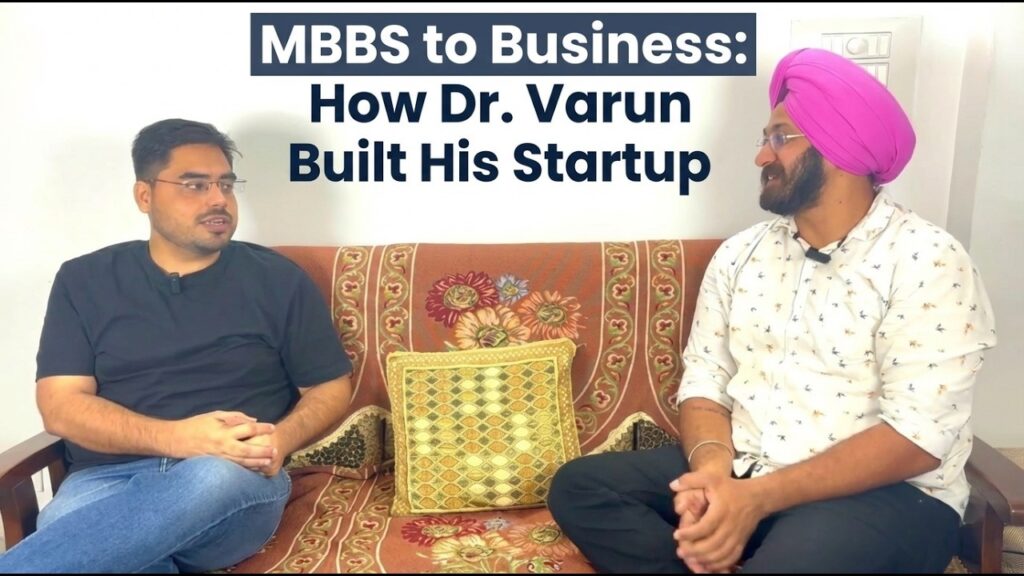
What happens when a doctor decides the hospital isn’t where he belongs anymore? For most people, a medical degree feels like a life sentence to clinical practice. But Dr. Varun took a very different path, one that went from patient wards to startup boardrooms, and his story might just make you rethink what you believe about career pivots, MBA degrees, and what it actually takes to build something from scratch.
This episode of Growth Hacks by Kuwar is a candid, wide-ranging conversation about professional reinvention, the real value of education, India’s manufacturing opportunity, and why curiosity might be the most underrated career skill of our time.
Meet Dr. Varun – The Doctor Who Outgrew the Clinic
Dr. Varun started his career with a clear goal: become an IAS officer. After that plan didn’t work out the way he hoped, he didn’t stay stuck. He pivoted to healthcare management, completed a Master’s in Hospital Administration, and went on to work in senior roles at some of India’s most well-known hospitals, including Medanta and Max Hospital in Delhi NCR.
He is now the founder of a medical consumables manufacturing business, producing intravenous fluids with multiple factories and export operations. His journey from doctor to administrator to entrepreneur gives him a perspective that very few people in the Indian startup ecosystem can offer.
When the Hospital Became a COVID Facility Overnight
One of the most gripping parts of this conversation is Dr. Varun’s account of managing Max Hospital during the COVID-19 pandemic, when the facility was converted into a dedicated COVID care centre. It sounds like a logistics challenge on paper, but the reality was far more human and far more difficult.
Beyond the operational complexity of restructuring an entire hospital, Dr. Varun describes the psychological toll on everyone involved. Patients isolated in ICUs without family contact experienced what is known as ICU psychosis. Staff dealt with burnout and fear. Administrators had to manage anxious relatives, departmental conflicts, and an institution operating at the edge of its capacity.
This experience gave Dr. Varun a very concrete understanding of what high-pressure leadership looks like. Conflict resolution, stakeholder management, and the ability to hold a team together under extraordinary stress are not skills you learn in a classroom. They are earned.
Why He Left a Stable Career for a Startup
After the pandemic, Dr. Varun made the leap into the startup world, joining a surgical care venture. The shift was significant. Hospital management, for all its challenges, is a structured environment with defined roles and hierarchies. A startup is the opposite.
He describes how working in a startup forced him to wear multiple hats simultaneously – marketing, sales, content creation, hiring – sometimes all in the same week. That kind of versatility is uncomfortable at first, but Dr. Varun sees it as the most valuable professional education he received. The freedom was real, but so was the responsibility.
His takeaway is direct: if you want to build a business, the fastest way to learn is to be inside one. Not studying one.
The Honest Truth About MBA Degrees
Dr. Varun has a clear and somewhat controversial view on MBA education, especially for people who want to start something of their own. His position is that a traditional MBA is useful if you want a structured corporate career or are looking to build a professional network. But for aspiring entrepreneurs, he believes it often falls short.
The core issue, as he sees it, is that most MBA programmes do not teach the practical hustle that startup life demands. They are built around case studies and frameworks, not the day-to-day reality of bootstrapping a business, handling rejection in sales, or making hiring decisions with limited information. His broader critique extends to Indian education more generally, which he feels separates theory from practice in ways that leave graduates underprepared for the working world.
This is not a dismissal of education. It is a call to rethink what education should actually deliver.
India’s Manufacturing Moment – And What Could Hold It Back
Dr. Varun runs a manufacturing business, so his perspective on India’s industrial opportunity carries real weight. He is genuinely excited about the shift in global supply chains away from China, and believes India has a historic window to step into that gap.
But he is also honest about what is standing in the way. The skill mismatch is significant. India has a young population and plenty of labour, but the hard skills required for precision manufacturing and the soft skills needed for workplace communication and collaboration are both underdeveloped. He points to China’s advantage as being rooted not just in infrastructure but in a workforce trained to a high standard of technical competency.
On the policy side, Dr. Varun acknowledges that government support for manufacturing startups is improving. Tax benefits, industrial land parks, and easier access to government procurement are all real opportunities. His caveat is that entrepreneurs need to actively research and pursue these schemes rather than assuming they will be handed to them.
The Surprising Warning About Social Media
Perhaps the most unexpected part of this conversation is Dr. Varun’s concern about what social media is doing to young professionals. He describes how shortened attention spans and the spread of misinformation through social platforms are quietly eroding two of the most important capabilities anyone can have: the ability to focus and the ability to think critically.
His advice is simple but countercultural. Read credible newspapers. Cultivate genuine curiosity. Build the habit of sustained attention. In a world designed to distract you, the ability to concentrate deeply on one thing is becoming rare, and therefore increasingly valuable.
Who Should Watch This Episode
If you are a young professional thinking about switching careers, someone who has wondered whether an MBA is really worth it, or an aspiring entrepreneur trying to understand India’s startup and manufacturing landscape, this episode has something concrete for you. Dr. Varun does not deal in abstract inspiration. He talks about what actually happened, what he learned, and what he would do differently.
Watch the full episode on the Growth Hacks by Kuwar podcast at growthhacksbykuwar.com and hear it directly from someone who has lived each of these transitions firsthand.